Coffee Drinks Chart
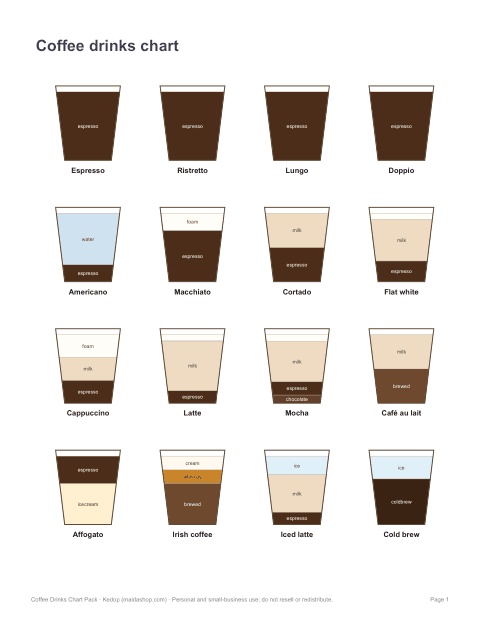
What exactly is the difference between a cortado and a flat white, or a cappuccino and a latte? This printable coffee drinks chart shows 16 popular drinks as layered cup diagrams — espresso, milk, foam, water and extras — with typical sizes and ratios, so customers, new baristas and home coffee lovers can see at a glance what goes into each cup.
Coffee Drinks Chart Pack
Coffee drinks poster with 16 cup diagrams, café menu board templates, barista cheat sheet cards, an espresso dial-in log and a price list with cost-per-cup calculator.
- Drinks poster (PDF)
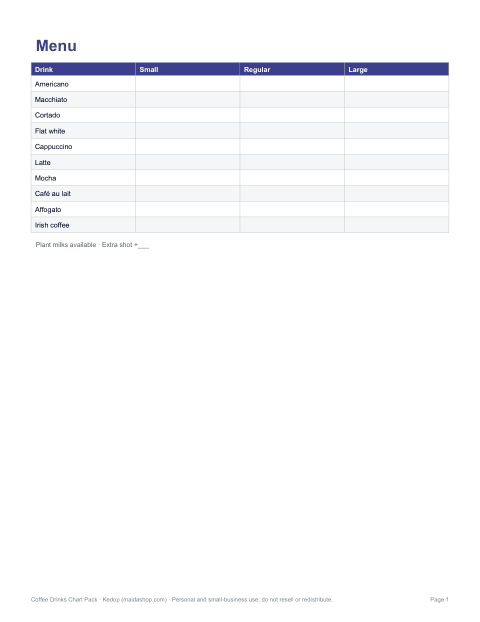
- Menu board (DOCX/PDF)
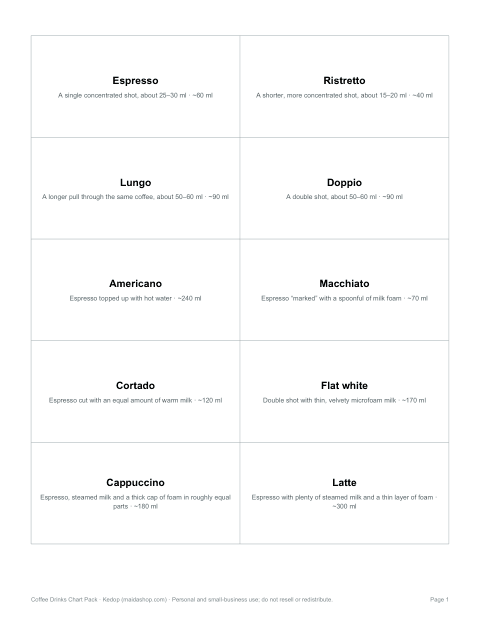
- Barista cards (PDF)
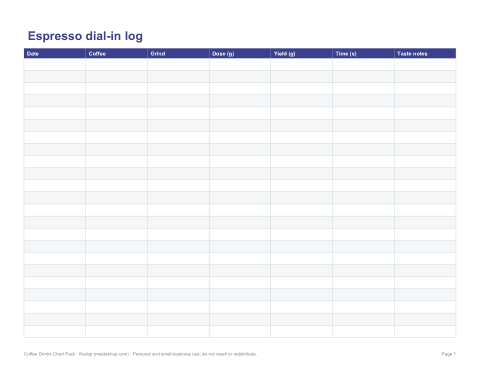
- Dial-in log (XLSX)
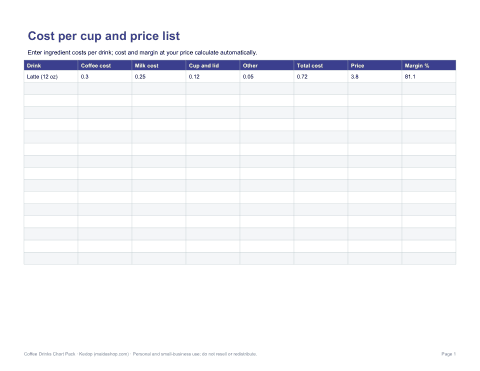
- Cost per cup (XLSX)
Formats: PDF, DOCX, XLSX. Instant download after payment (link valid 72 hours, up to 5 downloads). AI-assisted: the templates were drafted with AI help and reviewed and laid out by Kedop.
$5.00 USD, one-time
Secure card checkout by Stripe. Full refund within 7 days — see the refund policy and license.
Coffee drinks at a glance
| Drink | What’s in it | Typical size |
|---|---|---|
| Espresso | A single concentrated shot, about 25–30 ml | about 60 ml |
| Ristretto | A shorter, more concentrated shot, about 15–20 ml | about 40 ml |
| Lungo | A longer pull through the same coffee, about 50–60 ml | about 90 ml |
| Doppio | A double shot, about 50–60 ml | about 90 ml |
| Americano | Espresso topped up with hot water | about 240 ml |
| Macchiato | Espresso “marked” with a spoonful of milk foam | about 70 ml |
| Cortado | Espresso cut with an equal amount of warm milk | about 120 ml |
| Flat white | Double shot with thin, velvety microfoam milk | about 170 ml |
| Cappuccino | Espresso, steamed milk and a thick cap of foam in roughly equal parts | about 180 ml |
| Latte | Espresso with plenty of steamed milk and a thin layer of foam | about 300 ml |
| Mocha | A latte with chocolate | about 300 ml |
| Café au lait | Brewed (filter) coffee with hot milk | about 300 ml |
| Affogato | A scoop of vanilla ice cream “drowned” in espresso | about 120 ml |
| Irish coffee | Hot coffee, Irish whiskey and sugar, topped with cream | about 240 ml |
| Iced latte | Espresso and cold milk over ice | about 350 ml |
| Cold brew | Coffee steeped in cold water for 12–24 hours, served over ice | about 350 ml |
Sizes and ratios vary a lot between cafés and countries — a “latte” in one shop may be twice the size of another’s. The chart shows typical traditional proportions rather than a single correct recipe.
Milk drinks compared
| Drink | Espresso | Milk | Foam | Texture |
|---|---|---|---|---|
| Macchiato | Single or double | None | A spoonful | Strong, barely softened |
| Cortado | Double | Equal amount | Very little | Smooth and strong |
| Flat white | Double | Around twice the espresso | Thin microfoam | Velvety, coffee-forward |
| Cappuccino | Single or double | About equal to foam | Thick layer | Light and airy |
| Latte | Single or double | Plenty | Thin layer | Milky and mild |
Espresso basics
Espresso is made by forcing hot water, typically around 90–96 °C, through finely ground, tightly packed coffee at high pressure (around 9 bar) for roughly 25–30 seconds. A common starting recipe is a 1:2 ratio — about 18 g of ground coffee giving about 36 g of liquid espresso for a double shot. A ristretto uses less water for a sweeter, more syrupy shot; a lungo uses more for a lighter, more bitter one.
Using the charts in a café
- Put the cup diagram poster near the till so customers can point to what they want.
- Use the menu board templates to list drinks with your sizes and prices.
- Give new staff the barista cheat sheet cards with each drink’s build and cup size.
- Keep recipes consistent across shifts — the same dose, yield and milk volume every time.
- Add seasonal specials to the blank menu slots.
Milk alternatives
Oat, soy, almond and coconut drinks all steam differently. Barista versions of oat and soy drinks are formulated to foam well and are popular in flat whites and lattes; almond and coconut can be thinner and separate at high heat. Steam plant milks slightly cooler than dairy — around 55–60 °C — for the best texture and taste.
What’s in the pack
- Coffee drinks poster with 16 cup diagrams (PDF).
- Café menu board templates in three styles (Word and PDF).
- Barista cheat sheet cards with builds and cup sizes.
- Espresso dial-in log (Excel): dose, yield, time and taste notes.
- Price list template with cost-per-cup calculator (Excel).
Formats and printing
The poster prints on US Letter or A4 and scales to A3 or tabloid for display. Menu templates are editable in Word; the logs and price calculator are Excel workbooks that also open in Google Sheets.
AI-assisted content
Drink descriptions and ratios were compiled with AI assistance and reviewed by Kedop. They reflect common café practice; your recipes may differ.
Frequently asked questions
What is the difference between a latte and a cappuccino?
A cappuccino has more foam and less milk; a latte is milkier with a thin layer of foam.
What is a flat white?
A double shot with a smaller amount of velvety microfoam milk than a latte.
What is a cortado?
Espresso mixed with about the same amount of warm milk.
What is the difference between an americano and a long black?
Both are espresso and water; a long black pours the espresso over the water, keeping more crema.
Can I edit the menu templates?
Yes, they are editable Word files.
Is this a subscription?
No, it is a one-time download.